Faith
Fire & BloodThe Faith was both the dominant religious institution across much of Westeros and a political authority with which even the Targaryen kings had to reckon. Its High Septon could consecrate a ruler before assembled lords and worshippers, while its doctrines, courts, property, and religious orders shaped disputes far beyond the sept. The Faith’s accommodation of Aegon Targaryen’s rule helped bind conquest to religious recognition, but its refusal to accept later Targaryen marriages exposed the limits of that settlement.
Authority and Institutions
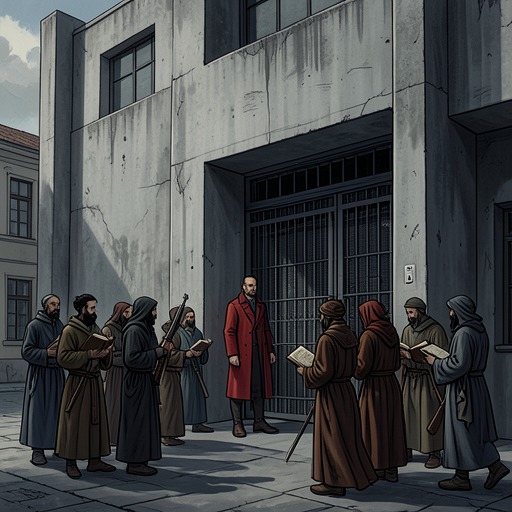
The Faith’s spiritual center was Oldtown, where the High Septon dwelt as the voice of the new gods on earth. Its authority extended throughout the kingdoms where the Faith was established, commanding the devotion of millions; the North, where the old gods held sway, was the principal exception. The Faith also had an armed presence. The Warrior’s Sons were a fighting order, known among the smallfolk as the Stars and Swords, and formed part of the broader Faith Militant.
The institution’s authority was not merely ceremonial. Aegon’s decrees exempted holy men and women, together with their lands and possessions, from taxation, and affirmed that the Faith’s own courts could try and sentence septons, Sworn Brothers, and holy sisters accused of wrongdoing. The arrangements gave the Faith protected property and jurisdiction under the new monarchy. Aegon was not himself especially godly, but he took care to court the support of the High Septon and the institution he led.
The Faith’s reach was also visible in the lives of the royal family. Maegelle, a quiet and studious daughter of Jaehaerys I and Alysanne, eagerly joined the Faith as a novice at ten; she read from the Seven-Pointed Star each night. Saera was later sent to Oldtown to begin instruction under her sister, Maegelle, and was publicly described as a novice destined for the silent sisters. Septon Barth understood the sentence as punishment rather than a sincere expectation that Saera would become a septa: the discipline and silence were meant to redirect her. These contrasting examples show the Faith as both a religious vocation and an institution through which royal conduct could be disciplined.
Accommodation with the Conqueror
When Aegon’s host approached Oldtown, its gates stood open and Lord Manfred Hightower offered his sword, city, and oath. The High Septon had spent seven days and nights praying and fasting in the Starry Sept. He concluded that resistance would bring the city’s destruction, and his counsel helped persuade Lord Hightower not to oppose the Conqueror by force. Oldtown’s submission therefore spared its men from the Field of Fire.
Three days later, in the Starry Sept, the High Septon anointed Aegon with the seven oils and placed a crown on his head, proclaiming him king and Protector of the Realm. This second coronation drew hundreds of lords and tens of thousands of cheering townspeople. Maesters and archmaesters from the Citadel were among those present, and this ceremony—not Aegon’s earlier crowning at the mouth of the Blackwater—became fixed as the beginning of his reign. The Faith’s participation gave religious and public force to a kingship first established by conquest.
That accommodation did not mean that the Faith endorsed every Targaryen custom. Aegon’s marriages to his sisters remained a source of tension. The High Septons of his reign did not openly condemn the king, but neither declared his marriages lawful; less senior members of the Faith continued to regard brother-sister marriage and plural marriage as sinful. The realm’s familiarity with Aegon’s two queens softened the immediate dispute, while leaving the underlying doctrinal conflict unsettled.
Marriage Doctrine and Open Conflict
The tension became explicit under Aenys I, when he announced the marriage of his eldest children, Aegon and Rhaena. The Faith had tolerated, or at least not challenged, the Conqueror’s marriages, but the High Septon denounced this union of grandchildren as an obscenity. His declaration warned that children of the match would be abominations in the sight of gods and men, and was read by ten thousand septons throughout the Seven Kingdoms. Religious condemnation thus reached well beyond Oldtown and made a royal marriage a public test of obedience.
Aenys neither abandoned the marriage nor attacked the Starry Sept. The wedding proceeded under the gaze of Warrior’s Sons, who lined the streets outside the Sept of Remembrance and watched the arriving guests. On the royal progress that followed, the couple encountered jeering crowds; at Maidenpool no septon would bless a feast held in their honor, and Lord Lucas Harroway refused them entry to his castle unless they recognized his daughter Alys as the lawful wife of Aenys’s uncle. In the riverlands, Poor Fellows pelted them with dirt. These were distinct expressions of hostility, from the withdrawal of religious rites to public harassment.
The dispute escalated after Septon Murmison, the King’s Hand, was expelled from the Faith for performing the forbidden wedding. Aenys wrote to the High Septon asking for Murmison’s restoration and explaining the Valyrian history of brother-sister marriage. The reply branded Aenys an abomination, pretender, and tyrant, denying his right to rule. Less than a fortnight later, Poor Fellows attacked Murmison in the city and hacked him to pieces. The Warrior’s Sons fortified the Hill of Rhaenys, turning the Sept of Remembrance into their citadel. After Poor Fellows broke into the king’s bedchamber, Aenys prepared to leave for Dragonstone with Queen Alyssa and their younger children. The Faith’s conflict with the crown had become a danger to the king’s person as well as a contest over doctrine.
Political Reach and Continuing Presence
The Faith’s influence also entered royal government through the people it trained and the judgments it claimed. When Jaehaerys condemned Ser Lucamore for violating his Kingsguard vows and secretly marrying three women, Alysanne emphasized that the wives had also been married in violation of religious marriage vows. Jaehaerys entrusted the resulting arrangements for Lucamore’s families to the queen, who offered some children religious or other placements. The episode does not make the Faith the judge of the case, but shows its moral vocabulary helping define the offense and the status of the families.
The institution’s public authority remained present at later royal ceremonies. When the High Septon was too old and frail to travel from Oldtown for Aegon II’s coronation, Septon Eustace anointed the king with holy oils and blessed him in the seven names of god. The ceremony proceeded without the High Septon himself, but still used the Faith’s rites to mark the accession.
Across these episodes, the Faith’s power depended on more than formal declarations. It could lend a conqueror the sanction of an ancient religious center, protect its own jurisdiction and wealth by royal decree, offer a path into religious life, and broadcast a condemnation through thousands of septons. Yet royal favor did not erase doctrinal disagreement, and religious authority did not always remain peacefully ceremonial. The unresolved question of Targaryen marriage turned accommodation into confrontation, revealing how closely spiritual legitimacy and political stability were joined.